

The Frontline Manager's Guide to Effective Coaching
How Better Coaching Creates More Consistent Execution, Stronger Customer Experiences, and Better Organizational Performance
Coaching Connects Strategy to Execution
Frontline managers occupy one of the most influential—and challenging—roles in any bank or credit union.
Every day, they balance operational demands, employee development, member expectations, regulatory requirements, and performance goals. Yet despite investing heavily in training, many financial institutions still experience inconsistent execution across branches and teams.
One branch consistently builds relationships and uncovers member needs. Another follows the same procedures but delivers a noticeably different experience.
What changed? In many cases, it isn’t the training.
It’s the coaching.
Effective coaching is the bridge between organizational strategy and frontline execution. Without it, even the best training programs gradually lose their impact.
This guide explores why coaching matters, why traditional coaching often falls short, and how financial institutions can create a coaching culture that drives stronger organizational performance.
Why Coaching Matters More Than Ever
Banks and credit unions invest millions each year in:
- Employee onboarding
- Sales and service training
- Customer experience initiatives
- Leadership development
- Operational improvement
Yet many executives still struggle to answer a simple question:
Are those investments producing consistent frontline execution?
Training provides knowledge; coaching creates consistency.
Training teaches employees what to do; coaching helps them do it consistently.
Without regular coaching, performance naturally begins to drift.

The Hidden Cost of Inconsistent Coaching
Execution rarely deteriorates overnight.
Instead, small inconsistencies begin appearing across everyday interactions.
A relationship-building question isn’t asked.
A follow-up call isn’t made.
A referral opportunity is missed.
Ownership becomes inconsistent.
These seemingly minor moments accumulate over time.
Eventually, organizations experience:
- Inconsistent customer experiences
- Reduced employee confidence
- Lower coaching effectiveness
- Missed growth opportunities
- Greater operational variation between branches
By the time traditional performance reports identify a problem, the behaviors that created it may have existed for weeks or months.
Why Traditional Coaching Often Falls Short
Most frontline managers genuinely want to coach their teams.
The challenge isn’t commitment.
It’s visibility.
Managers often rely on:
- Annual training programs
- Branch observations
- Performance reviews
- Complaint resolution
- Sales reports
- Customer satisfaction scores
These tools are valuable — but they’re largely retrospective.
They explain what happened.
They don’t always reveal:
- Where execution is becoming inconsistent
- Which behaviors need coaching first
- Which teams require additional support
- Where performance is beginning to drift
As a result, coaching often becomes reactive rather than proactive.
What Effective Coaching Looks Like
High-performing organizations approach coaching differently.
Rather than focusing only on outcomes, they coach the behaviors that create those outcomes.
Effective coaching is all of the following:
Timely
Feedback occurs close to the behavior—not weeks later.
Specific
Managers coach observable behaviors rather than offering general advice.
Consistent
Every employee receives coaching—not only struggling employees.
Development-Oriented
Coaching is viewed as employee development rather than performance correction.
Priority-Driven
Employees understand why certain behaviors matter because they support broader organizational goals.
The Five Coaching Questions Every Frontline Manager Should Ask
- Where is execution becoming inconsistent?
- Which behaviors create the greatest impact?
- Customer relationships
- Service quality
- Ownership
- Follow-through
- Problem resolution
- What patterns are emerging?
- What barriers are employees experiencing?
- How will improvement be measured?
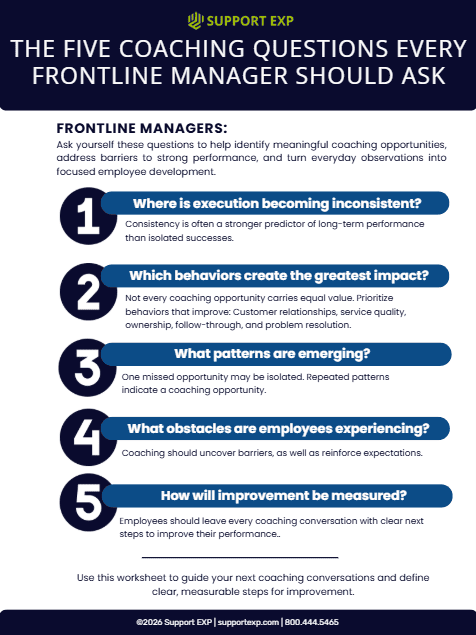
Download: The Five Coaching Questions Every Frontline Manager Should Ask
Use this worksheet to prompt your coaching conversations
From Customer Experience to Coaching Intelligence
- Which behaviors contributed to this experience?
- What patterns are emerging?
- Which managers should coach which teams?
- Where should coaching begin?
Building an Effective Coaching Culture
Organizations that consistently outperform their peers don’t rely on occasional coaching conversations. They build coaching into everyday leadership.
Successful coaching cultures share several characteristics:
- Leaders prioritize coaching alongside operational management.
- Coaching is based on objective insights rather than assumptions.
- Managers receive coaching on how to coach.
- Employee development becomes continuous rather than event-based.
- Success is measured by improved behaviors as well as business outcomes.
Over time, coaching evolves from an activity into a leadership capability.
Signs Your Coaching Program Needs Improvement
Consider these questions:
- Do managers spend more time reacting than coaching?
- Are coaching conversations driven primarily by complaints?
- Do branches deliver noticeably different customer experiences?
- Are training investments producing inconsistent results?
- Do managers know where coaching will have the greatest impact?
If the answer to several of these questions is yes, your organization may be experiencing execution drift that isn’t yet visible in traditional reporting.
If your organization is looking to improve coaching effectiveness, strengthen frontline execution, and create more consistent customer or member experiences, we’d welcome the opportunity to discuss how Support EXP can help.
Recommended Next Read: