

What Causes Performance Drift in Credit Unions?
Why Performance Breaks Down — And How to Fix It
What is Performance Drift?
Performance drift is the gradual breakdown between leadership expectations and actual frontline behavior over time.
The result: inconsistent execution and declining member experience.
It doesn’t happen all at once. It shows up slowly:
- Branches start performing differently
- Member experience becomes inconsistent
- CX scores stall or decline
Why Performance Drift Happens
Most credit unions don’t lose performance because of strategy.
They lose it because execution breaks down.
The problem:
Credit unions measure performance — but don’t consistently manage execution.
What Credit Unions See (Too Late) When Performance Drifts
- Inconsistent or stagnant growth
- Missed relationship-building opportunities
- Uneven branch/team performance
- Lower member retention
- Stalled ROI from training and CX investments
- Reduced effectiveness during growth or merger periods
5 Signs Your Credit Union is Experiencing Performance Drift
Inconsistent frontline performance
Members receive different experiences across locations or channels
Stagnant or declining CX scores
NPS, CSAT, or CES stop improving despite continued investment
Feedback isn’t driving action
You collect member data — but don’t see meaningful change
Lack of clear ownership
No one is accountable for improving performance outcomes
Performance drops during change
Mergers, growth, or transformation create instability
Why Most Credit Unions Don’t Catch Performance Drift Early
Performance drift is difficult to detect because:
- It happens gradually
- Metrics lag behind real performance
- Leadership sees averages—not variability
Most institutions discover performance drift only after growth, loyalty, or retention metrics begin to fall.
By the time it’s visible…
…member experience has already declined
How To Prevent Performance Drift
Strengthen ownership
• Define who owns performance at every level
• Align accountability with outcomes
Improve insight-to-action speed
• Reduce lag between feedback and response
• Make signals visible in real time
Reinforce frontline execution
• Standardize expectations
• Coach behavior consistently
• Monitor performance continuously
“Performance drift isn’t a data problem — it’s an execution problem.“
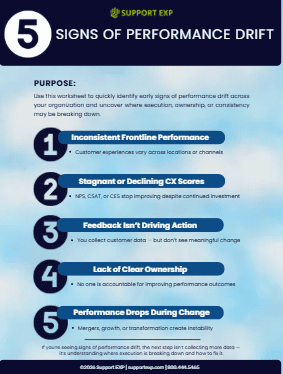
Download: 5 Signs of Performance Drift
Use this quick worksheet to assess your organization
Leadership Reflection and Discussion Questions
- What data or behaviors indicate execution is slipping?
- Are we solving root causes or reacting to symptoms?
- Where are processes breaking down or slowing results?
- Do teams have the clarity and resources needed to perform well?
- How quickly are we identifying and addressing problems?
- Are accountability and expectations clearly defined?
- What can we do now to prevent future drift?
If you’re seeing signs of performance drift, the next step isn’t collecting more data — it’s understanding where execution is breaking down and how to fix it.
Recommended Next Read:
Frontline Performance in Banking: What Customer Metrics Don’t Reveal