
Customer Experience (CX) Metrics FAQs for Banking Executives
Straight answers to questions banking leaders ask about key CX metrics like NPS, CSAT, and CES — with descriptions, benchmarks, and how to link CX growth and efficiency.
What are the key customer experience metrics in banking?
The most important customer experience metrics for banks are Net Promoter Score (NPS), Customer Satisfaction (CSAT), and Customer Effort Score (CES). These provide a complete picture of how customers perceive your institution, how satisfied they are, and how easy it is to interact with you.
- NPS gauges customer loyalty by asking, “How likely are you to recommend our bank to a friend or colleague?” It measures advocacy and long-term relationship strength.
- CSAT measures satisfaction with a specific service interaction, product, or transaction. It’s a pulse check on operational excellence.
- CES evaluates the ease of completing a transaction or process, such as applying for a loan, resolving an issue, or navigating digital banking tools.
Together, these metrics allow executives to diagnose what’s working, uncover friction, and link customer sentiment directly to financial outcomes.
Why do NPS, CSAT, and CES matter for banking executives?
Customer experience directly influences growth, retention, and profitability in banking. High-performing institutions use CX metrics as a management system—not just a survey score. For example, an increase in NPS is often correlated with higher deposit growth and lower churn, while reducing customer effort (CES) can improve operational efficiency and lower servicing costs.
Each metric reveals a different strategic dimension:
- NPS (Loyalty) – Indicates relationship strength and likelihood to refer others. High NPS scores often reflect trust, convenience, and emotional connection.
- CSAT (Satisfaction) – Measures the perceived quality of specific interactions or channels. Consistent high CSAT across branches and digital channels signifies reliable delivery.
- CES (Ease) – Reflects how simple it is for customers to accomplish what they need. A lower CES indicates streamlined processes and intuitive digital experiences.
Executives who integrate these metrics into business scorecards can identify root causes of attrition, monitor digital transformation progress, and align employee behavior with customer goals.
What's a good NPS score for banks and credit unions?
Benchmarking NPS in banking depends on region and market segment, but general benchmarks include:
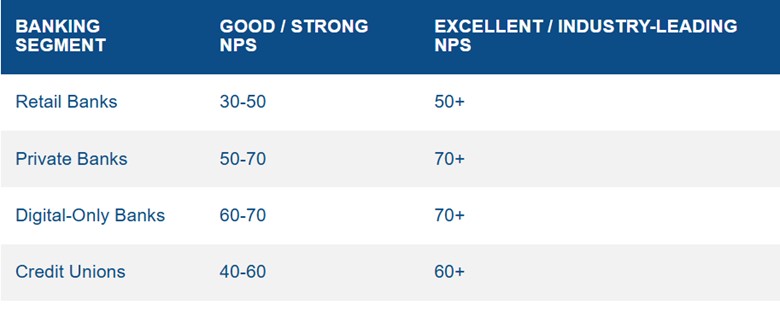
For credit unions, NPS scores are often higher — typically ranging from 45 to 85 — reflecting stronger member relationships and local trust. Scores above 60 are generally considered excellent in that segment.
A high NPS shows strong advocacy and retention potential. But success also depends on closing the loop — analyzing feedback, responding to detractors, and mobilizing promoters to share positive stories. The real power of NPS lies in its use as a catalyst for improvement rather than a static score.
How is CSAT measured in financial institutions?
Capturing CSAT usually involves short, post-interaction surveys that ask customers to rate their satisfaction on a numeric scale (typically 1–5 or 1–7). The question might read: “How satisfied were you with your recent experience?” Tracking CSAT over time helps prioritize process improvement, staff training, and technology investment.
Best practices include:
- Survey immediately after the interaction (e.g., transaction, call, or app session).
- Use a consistent scale across channels to ensure comparability.
- Monitor scores by channel (branch, mobile, call center) and journey (loan origination, account opening, fraud resolution).
What is CES and why is it critical for banking?
Customer Effort Score (CES) quantifies how easy it is for customers to accomplish their goals. In a digital-first banking world, low effort equals high loyalty. A CES survey typically asks, “How easy was it to resolve your issue or complete your task?” on a 1–7 scale (1 being ‘very difficult,’ 7 being ‘very easy’).
Low effort correlates strongly with higher adoption, satisfaction, and reduced attrition. For example, simplifying authentication, speeding up application approvals, and offering self-service tools can significantly improve CES.
Banks that monitor CES closely tend to identify friction early, optimize touchpoint design, and reduce operational costs. More importantly, they know precisely where and how to act to reduce customer frustration.
How do CX metrics connect to business outcomes like retention and profitability?
Research consistently shows that improving CX metrics drives tangible financial outcomes across growth, efficiency, and risk. Executives integrate these metrics to inform strategic planning, justify transformation programs, and link customer sentiment directly to KPIs.
The key relationships are:
- NPS (Net Promoter Score) → Growth & CLV: Loyal customers are up to five times more likely to refer and repurchase. A 10-point rise in NPS is directly correlated with a measurable increase in Customer Lifetime Value (CLV) and higher deposit share growth.
- CES (Customer Effort Score) → Cost Efficiency & Automation ROI: Reducing customer effort drives down the average Cost-to-Serve (CTS). Simplifying processes (improving CES) lowers operating costs by reducing agent escalations, call-backs, and support tickets by up to 15%.
- CSAT (Customer Satisfaction) → Retention & Cross-Sell: Satisfied customers are less price-sensitive and more forgiving of occasional issues. High CSAT across channels correlates with lower churn risk and higher success rates for cross-selling new products.
These metrics serve as leading indicators for the board, allowing leaders to measure the return on investment (ROI) of digital transformation and operational excellence initiatives.
How often should banks measure and review CX metrics?
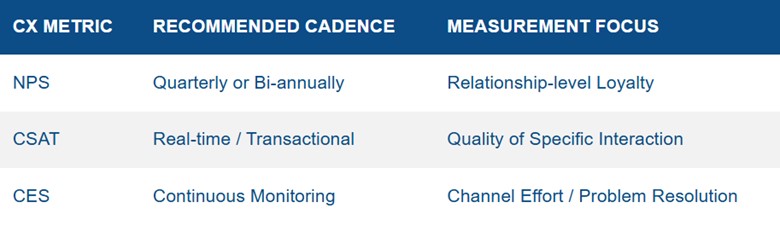
Continuous feedback is essential to stay agile. Monthly text analytics and root-cause analysis sessions help transform data into action. Executive teams should review CX dashboards at least monthly to identify emerging issues or opportunities.
What are emerging trends in measuring customer experience in banking?
Latest trends in the rapidly evolving field of customer experience measurement include:
- Real-time CX dashboards integrating multiple metrics and voice-of-customer sources.
- Predictive analytics to identify customers at risk of churn before they leave.
- Text and speech analytics powered by AI to uncover hidden sentiment patterns in call and chat transcripts.
- Employee experience linkage — connecting internal engagement data with CX results.
- Journey-based CX governance replacing channel or departmental silos with end-to-end accountability.
As AI and automation advance, banking leaders will increasingly shift from descriptive to predictive and prescriptive CX management, increasing the capacity to anticipate customer needs and customize engagement.
How can executives take action on customer experience data?
The real value of CX metrics comes from how leaders use this data to drive organizational change. To act effectively:
- Prioritize investments based on areas of greatest customer impact, such as improving digital onboarding or reducing complaint resolution times.
- Close the loop by contacting detractors and resolving their issues swiftly—demonstrating responsiveness.
- Empower employees with access to feedback dashboards and training to influence the drivers of CX performance.
- Tie NPS, CSAT, and CES to KPIs, incentives, and performance reviews to build a customer-centric culture.
- Report CX data to boards and regulators alongside financial and risk metrics, showing governance maturity.
Ultimately, acting on CX data transforms it from an operational measure into a strategic differentiator, enabling banks to create a measurable competitive advantage.
What is the immediate impact of Generative AI on how banks should measure and govern CX metrics?
Generative AI (Gen AI) and predictive analytics are shifting CX measurement from descriptive (what happened) to prescriptive (what to do next).
The immediate impacts for executives are:
- Real-Time Root Cause Analysis: Gen AI rapidly analyzes vast volumes of unstructured data (call transcripts, chat logs, email text) to uncover the specific operational friction driving drops in NPS and increases in CES. This allows for near real-time intervention instead of waiting for quarterly reports.
- Hyper-Personalization Measurement: AI enables hyper-personalized interactions (e.g., tailored alerts, custom advice). CX teams must now measure the specific impact of these personalized touches on individual CSAT scores and track the resulting change in customer behavior (e.g., cross-sell conversion rates).
- Digital Efficiency Metrics: AI-powered self-service and chatbots handle a majority of routine inquiries. CX governance must now rigorously track the success of these automations using First Contact Resolution (FCR) for AI and Deflection Rates to quantify the direct cost savings (reducing cost-to-serve).
- Ethics and Bias: Executives must establish clear governance frameworks to ensure AI models used in CX measurement and personalization are explainable and unbiased, mitigating regulatory risk and maintaining customer trust. The integrity of the CX score is tied to the integrity of the data inputs.
Want to find out more about using customer experience metrics to drive predictable growth?
Download our executive insights article, “Turning CX Insights into Income: 5 Customer Experience KPIs That Fuel Banking Success” —


