

Is Your Frontline Coaching Truly Driving Performance?
A Maturity Guide for Banking Leaders
Frontline service is where a bank or credit union’s brand is either reinforced or quietly eroded. Yet, despite good intentions, many coaching and training programs remain reactive, inconsistent, or disconnected from business outcomes.
High-performing financial institutions treat frontline coaching not as an HR initiative, but as a strategic performance lever.
Here’s a practical maturity guide banking leaders can use to evaluate where their organization stands, and what to improve next.
Why Maturity Matters in Banking
In retail banking and credit unions, frontline execution influences:
- Customer/member retention
- Cross-sell effectiveness/depth of relationship
- Complaint escalation and reputational risk
- Digital/new product adoption
- Brand trust and advocacy
Coaching is the mechanism that translates strategy into behavior at the point of service. Without maturity in coaching systems, even the best strategy stalls at the point of customer contact.
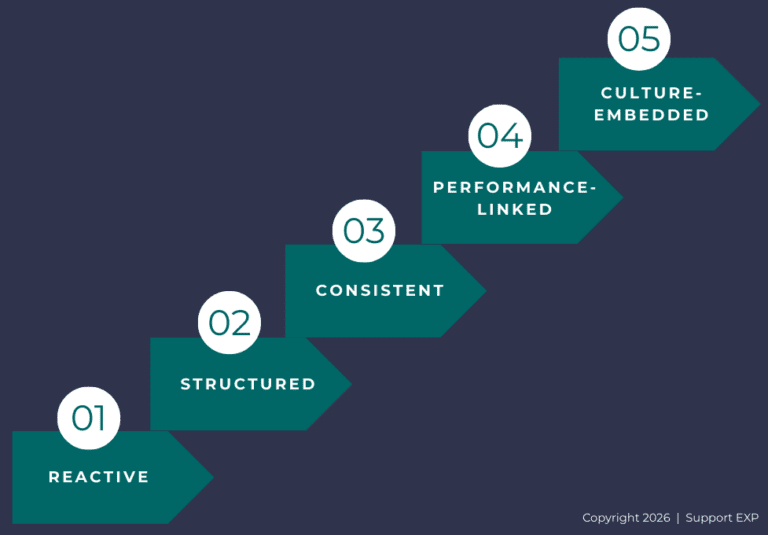
Level 1: Reactive
“We coach when there’s a problem.”
At this stage, coaching is inconsistent and usually triggered by complaints, audit failures, or poor scores. Training is sporadic and event-based, with limited reinforcement.
Indicators:
- Coaching conversations revolve around metrics (“Your score dropped.”)
- No structured coaching framework
- Training occurs during onboarding or rollouts, not continuously
- Little visibility into whether coaching improves outcomes
This stage is compliance-driven, not performance-driven.
Level 2: Structured
“We have standards, but application varies.”
Here, leadership has defined service standards and expectations. Coaching conversations are more intentional, though heavily dependent on individual managers.
Indicators:
- Clear service expectations exist
- Some documentation of coaching
- Inconsistent coaching quality across branches and teams
- Limited linkage between coaching and business KPIs
This stage shows progress, but execution gaps remain.
Level 3: Consistent
“Coaching is part of how we operate.”
Coaching becomes embedded in routine management practices. Leaders align around observable behaviors and use shared tools to guide conversations.
Indicators:
- Behavior-based coaching (not just score reviews)
- Standardized coaching frameworks
- Calibration among managers
- Coaching frequency is tracked and monitored
At this stage, performance conversations shift from evaluation to development.
Level 4: Performance-Linked
“We can see the impact of coaching.”
The organization begins connecting frontline behaviors to measurable outcomes such as retention, product adoption, customer/member satisfaction, and operational improvement.
Indicators:
- Trend analysis before and after coaching interventions
- Branch-level performance comparisons
- Training content shaped by real performance gaps
- Coaching aligned to strategic priorities
Leaders no longer ask, “Did we coach?”
They ask, “Did our coaching move the needle?”
Level 5: Culture-Embedded
“Coaching is part of our identity.”
At the highest level of maturity, coaching is continuous, transparent, and trusted. Employees seek feedback as part of professional growth, and managers see team development as a core leadership responsibility.
Indicators:
- Coaching is proactive and forward-looking
- Recognition reinforces desired behaviors
- Employees understand scoring criteria and expectations
- Data flows quickly enough to enable near-term adjustments
- Service excellence is consistently modeled by leadership
Here, coaching drives culture, not just compliance.
The Five Questions Banking Leaders Should Ask
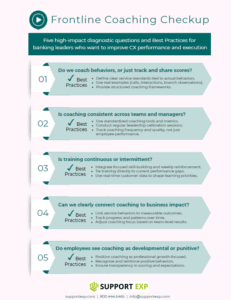
To quickly assess your organization’s maturity, consider:
- Do we coach behaviors, or just track and share scores?
- Is coaching consistent across teams and managers?
- Is training continuous or intermittent?
- Can we clearly connect coaching to business impact?
- Do employees see coaching as developmental or punitive?
If answers vary widely across your organization, your program likely sits between levels two and three. If you cannot quantify impact, you’re not yet at performance-driven maturity.
The Bottom Line, The Next Step
Strong frontline coaching programs don’t rely on heroic managers or one-time training sessions. They operate as structured, measurable systems that continuously reinforce the behaviors that matter most.
With today’s demanding banking environment, it’s not enough to say that your organization is coaching your frontline employees.
Your coaching system needs to be mature enough to drive performance. Take the next step and reach out to our performance consultants today!
Recommended next read: How to Improve Customer Service: Strategies for Banks and Credit Unions
How Support EXP Turns Insight into Sustained Performance
Support EXP provides a complete NPS and CX execution system designed specifically for credit unions and banks.
Unlike survey-only platforms, Support EXP integrates Relationship and Transactional NPS with Customer Effort (CES) and satisfaction (CSAT), translating feedback into clear priorities and action across all channels.
Leading financial institutions of all sizes use Support EXP not just to measure customer loyalty, but to align employee behavior, performance, and operational decisions to the experiences that actually sustain growth.