

When Your CX Platform Changes: What Smart Organizations Do Next
Across industries, customer experience programs are evolving.
The upcoming sunsetting of the Delighted survey platform in 2026 is one example of a broader trend: organizations periodically find themselves needing to rethink the systems they rely on to understand customer experience.
When that moment arrives, most leadership teams instinctively focus on one question:
What tool should replace the current platform?
But organizations that gain the most long-term value ask a different question.
How should we redesign the listening system behind our customer feedback program?
That distinction turns out to matter far more than the platform itself.
The Two Paths Organizations Take
Path 1: Replace the Tool
The most common response is to search for another platform that replicates the functionality of the existing system.
Teams evaluate options, select a new vendor, migrate the survey infrastructure, and continue collecting feedback.
This approach is understandable. It solves the immediate operational problem.
But many organizations discover that simply replacing the platform does not address deeper challenges, such as:
- limited insight into what customers are actually experiencing
- difficulty translating feedback into operational action
- delayed visibility into emerging issues
- uncertainty about how insights should inform leadership decisions
Replacing the tool often preserves the same listening structure that was already struggling.
Path 2: Improve the Listening System
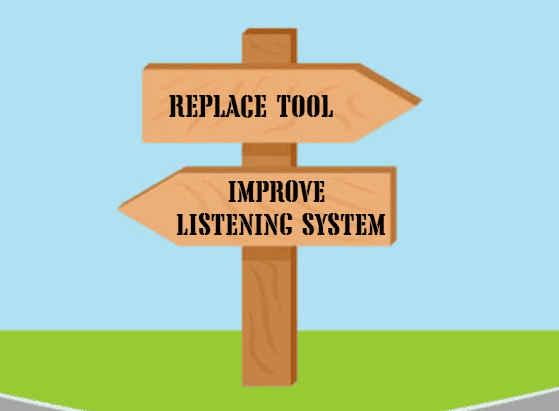
A smaller group of organizations uses platform transitions as an opportunity to rethink how their listening programs actually function.
Instead of focusing first on technology, they ask questions such as:
- What insight does leadership need to make better decisions?
- How quickly should emerging customer issues become visible?
- How should feedback translate into operational improvement?
- Who owns interpreting the signal coming from customer data?
From there, the organization designs the listening structure that will support those objectives.
Only then do they determine what tools best support that system.
In many cases, this approach produces dramatically stronger CX programs because the technology becomes an enabler rather than the centerpiece.
Why Listening Structure Matters
Customer feedback programs often fail for a simple reason: collecting feedback is easier than translating it into meaningful action.
Most platforms focus on measurement — gathering scores, comments, and survey responses.
But leadership teams often need something different:
- early visibility into emerging customer friction
- clarity about where operational breakdowns are forming
- insight that helps prioritize improvement efforts
- signals that support coaching and frontline development
Without a well-designed listening structure, feedback data accumulates while operational insight remains limited.
The Role of Technology
Technology absolutely plays an important role in modern CX programs.
Platforms enable organizations to collect feedback across channels, monitor sentiment, and respond to customer concerns.
However, technology alone rarely solves the core challenge.
The most successful programs combine three elements:
- Thoughtful listening design
- Insight interpretation
- Operational response
When those elements are aligned, feedback becomes a powerful leadership tool rather than simply another reporting stream.
A Second Layer: Visibility Into Execution
As listening programs mature, many organizations discover an additional need: understanding how frontline execution is evolving over time.
Performance drift often begins subtly — long before it appears in experience scores or financial outcomes.
For this reason, some institutions add a second layer focused on execution visibility, giving leadership earlier signals of where performance gaps may be forming.
This type of insight helps organizations protect growth by identifying emerging issues before they become systemic.
A Moment of Opportunity
The Delighted sunset is affecting thousands of organizations that relied on the platform for customer feedback.
For some teams, the immediate goal will be simply replacing the tool.
But for others, the transition offers something more valuable: the opportunity to redesign how customer insight supports leadership decisions and operational improvement.
When CX programs evolve in this way, feedback becomes far more than a score.
It becomes a strategic asset.
Plan Your Post-Platform Strategy in a CX Transition Briefing
Because many organizations are currently navigating CX program changes, Support EXP is offering a limited number of CX Transition Briefings.
These short sessions share what we are seeing across institutions as they rethink their listening programs and customer insight strategies.
The briefing covers:
- how CX listening programs are evolving
- the two paths organizations typically take during platform transitions
- how listening structures support leadership decisions
- where execution visibility may become important over time
Interested in scheduling your own CX Transition Briefing? Request a session through the link below!
Discover the CX Turning Point
The next era of customer loyalty won’t be won by better scores — it will be won by leaders who understand the friction their customers feel and remove it before it becomes attrition. Get clarity into the forces that will define loyalty in 2026 and beyond.